Charles Henry Bainbridge & The Salonika Front

Charles Henry Bainbridge (1886–1942) was a farm labourer who served during WWI and despite the odds, survived to return home to his family. Born in rural Yorkshire, his military service with the Royal Engineers during World War I took him across Europe and into the Caucasus. He survived extreme climates and a grueling battle with chronic malaria to return to his home county, where he became a vital part of Selby’s industrial workforce.
Early Life, Marriage, and Pre-War Career
Charles Henry Bainbridge was born on October 19, 1886, in the rural village of Chapel Haddlesey, Yorkshire, England, the first of a new generation whose parents had left Tollerton and Sutton on the Forest. He was our 1st cousin 3x removed, therefore 1st cousin to our great grandfather John Henry BAINBRIDGE. Growing up in the agricultural heartland of the West Riding of Yorkshire, he began working the land at a young age.
In 1909, Charles married Mary Wilson (1883-1977) in Selby Abbey. By the time of the 1911 Census, the young family was established at White House Cottage in Barlow, a small village just south of Selby. At age 23, Charles was working hard as a farm labourer, providing for Mary and their eight-month-old son, Charles Reginald, and their two subsequent children. This experience in demanding, physical labour sharpened the stamina and practical problem-solving skills that would later define his military service.
World War I Service (1916–1919)
Enlistment and the Royal Engineers
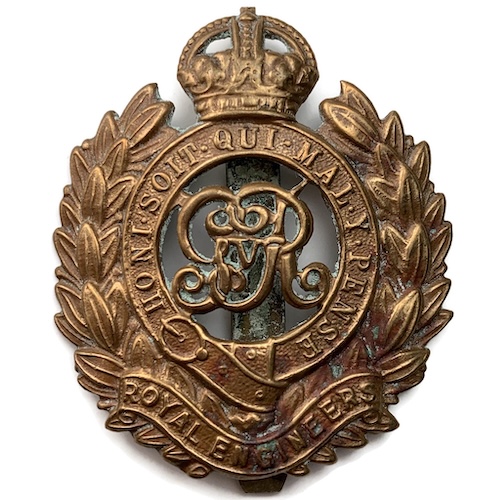
As Great War casualties mounted and Britain transitioned toward conscription, Charles stepped forward. On April 9, 1916, at the age of 29, he officially attested for military service in Selby. Because of his aptitude for technical labour, he was given the rank of Pioneer (denoting a skilled craftsman or technical labourer) and assigned to the Royal Engineers Signals – the vital branch responsible for the British Army’s battlefield communications.
Charles spent the next two years undergoing rigorous training. He remained in England until his formal mobilization at York in April 1918, preparing for deployment to one of the war’s most punishing and neglected theatres.

The Salonika Front (1918)
On August 31, 1918, Pioneer Bainbridge arrived on the Salonika Front in Macedonia, Northern Greece, as part of the British Salonika Force (BSF). He stepped into a landscape of brutal extremes—dominated by roadless mountains, deep ravines, and mosquito-infested valleys.
Charles arrived at a historic turning point. Allied forces were finalizing preparations for the massive Vardar Offensive (launched September 15, 1918) to break a years-long stalemate against Bulgarian and German forces. As a Signal Pioneer, Charles performed punishing, high-stakes physical labour:

Infrastructure Under Fire: He laid miles of heavy telephone and telegraph lines across rocky peaks, often splicing severed wires under active artillery fire.
The Environment: He battled scorching Mediterranean dust storms and freezing night temperatures.
The Epidemic: The stagnant valleys were breeding grounds for malaria.
While the lightning-fast offensive successfully forced Bulgaria to sign an armistice on September 30, 1918, the marshy terrain left a permanent scar. Charles contracted a severe strain of malaria from the marshy, mosquito-ridden, valleys of Macedonia, which then went dormant in his system.

The Caucasus Campaign and Illness
Following the rapid collapse of the Ottoman Empire, Charles’s unit was not sent home. Instead, they were absorbed into the Army of the Black Sea and rapidly redeployed eastward into the Caucasus as part of the British Caspian Expeditionary Force. Their strategic directive was to take operational control of regional infrastructure and secure it from Bolshevik or German-allied remnants.
By December 6, 1918, Charles was stationed in Tbilisi, Georgia (then Tiflis). His Royal Engineers Signals unit was tasked with managing communications along the vital Trans-Caucasus Railway5 to safeguard oil shipments from Baku to the Black Sea.
The sub-zero Georgian winter and sheer physical exhaustion finally broke his immune system. The extreme cold triggered a violent, incapacitating malarial relapse. Invalided out of active combat, Charles was loaded onto a westward-bound medical transport train over the snowy Surami Pass. On January 12, 1919, while waiting at the chaotic, overcrowded transit port of Batumi, Georgia, he suffered another severe relapse. He was promptly evacuated from the theatre on an Allied hospital ship.

Timeline of Pioneer Bainbridge
- Apr 1916: Attestation in Selby, Yorkshire
- Apr 1918: Mobilisation, York, Yorkshire ──>
- Aug 1918: Salonika Front, Macedonia ──>
- Dec 1918: Caucasus Front, Tbilisi, Georgia ──>
- Jan 1919: Transit & Evacuation, Batumi, Georgia ──>
- Aug 1919: War Hospital in Warrington, Chesire ──>
- Sep 1919: Malaria Centre, Shoreham-by-Sea, Sussex ──>
- Nov 1919: Demobilization to Selby, Yorkshire

Hospitalization and Discharge
Charles spent the spring and summer of 1919 moving slowly through the vast British military medical evacuation pipeline, undergoing treatment at Mediterranean staging bases (likely Malta or Egypt) to suppress his chronic malaria.
- August 31, 1919: Exactly one year after he first landed in Salonika, Charles arrived back in England. He was immediately admitted to The Lord Derby War Hospital in Warrington, Cheshire, a massive 3,000-bed facility, for an intensive 28-day course of stabilization treatment.
- September 10, 1919: As his acute symptoms stabilized, he was transferred to the specialized military Malaria Centre at Shoreham-by-Sea in Sussex, where the coastal air and regulated quinine regimens helped suppress long-term relapses.
- October 16, 1919: A specialized medical board assessed Charles with a 20% disability rating caused by chronic malaria, granting him a temporary six-month disability pension to aid his financial transition.
- November 15, 1919: Charles was officially transferred to the Class “Z” Army Reserve. Returning to civilian life as a reservist, his liability for recall officially expired on March 31, 1920, permanently concluding his active wartime service.
Post-War Life and Industrial Career


Charles returned home to Yorkshire to reunite with Mary and their two surviving children. By February 4, 1920, the family was registered at 23 Olympia Cottages, Barlby Road, Selby. This community consisted of purpose-built housing for the workers of the Olympia Oil & Cake Company Ltd.,10 a massive local animal feed and seed-crushing mill. Transitioning from his pre-war agricultural roots, Charles entered the booming processing industry.
Charles’s health rebounded from his wartime illness, and he built a long-term career at the mill. By the time the 1939 England and Wales Register was compiled on the eve of World War II, the family had moved to 1 Thomas Street, Selby. Charles, now 53, had been promoted to Charge Hand in the Oil Mill, a vital supervisory foreman role, and ultimately Silo Manager as listed on his death certificate.
Death and Legacy
Charles Henry Bainbridge passed away on October 27, 1942, at the age of 56 in Howden, Yorkshire. Cause of death was Acute Miliary Tubercle/Tuberculosis. At the time of his death, effective antibiotic treatments for tuberculosis (such as streptomycin) had not yet been discovered or widely deployed, making acute miliary cases heavily fatal.
Because he died intestate during the height of World War II, his financial affairs were handled by the Principal Probate Registry, which had been evacuated to Llandudno, Wales, for safety from enemy bombings. Legal administration of his estate—valued at a respectable £230 18s—was granted to his widow, Mary, on February 19, 1943. Mary remained the matriarch of the family until her passing at the age of 93 in 1977.
Charles’s legacy is one of quiet resilience: surviving a grueling, lesser-known theatre of the First World War, overcoming a disabling tropical disease, and returning home to transition from a humble farm labourer into a respected leader in his local industrial community.
Family Tree
Charles was one of four first cousins who all share grandparents Henry BAINBRIDGE (1831-1891) & Jane SCOTT (1828-1872), our 3rd great grandparents. Each of their children had one child who volunteered to serve their country. The eldest son John Bainbridge and wife Harriet raised eight children to adulthood, the fifth of which was Charles.
- Henry BAINBRIDGE (1831-1891) & Jane SCOTT (1828-1872)
- John Bainbridge (1859-1935) & Harriet Ann Jenkinson (1860-1922)
- Bertha Pearson Jenkinson (1877-1970)
- Thomas Bainbridge (1881-1881)
- Jane Ann Bainbridge (1882-1959)
- John Jenkinson Bainbridge (1885-1959)
- Gertrude Bainbridge (1885-1964)
- Charles Henry Bainbridge (1886-1942) & Mary Wilson (1883-1977)
- Charles Reginald Bainbridge (1910-1977)
- Kathleen Mary Bainbridge (1911-1934)
- Alice Bell Bainbridge (1916-1920)
- George Stephen Bainbridge (1893-1967)
- Ada Mary Bainbridge (1894-1977)
- Sarah Amelia Bainbridge (1898-1974)
- Charles BAINBRIDGE (1861-1935) & Elizabeth A HEADLEY (1863-1935)
- Mary Jane Bainbridge (1884-?)
- Elizabeth Isabel Bainbridge (1886-1964)
- Charles Ernest Bainbridge (1887-1965)
- Arthur Bainbridge (1890-1939)
- John Henry BAINBRIDGE (1892-1940) & Adelaide EDGAR (1888-1975)
- Charles Reginald BAINBRIDGE (1915-1994) & Winifred May THOMPSON (1920-1977)
- Our direct line…
- Charles Reginald BAINBRIDGE (1915-1994) & Winifred May THOMPSON (1920-1977)
- Mary Ann Bainbridge (1863-1925) & James Dunnington (1862-1936)
- Henry Dunnington (1886-1918) & Eliza Ann Abrahams (1881-?)
- Ada M Bainbridge (1866-1951) & Thomas Scatchard (1857-1906)
- Henry Scatchard (1897-1939) & Emily Rotherforth (1898-1981)
- Lucy Scatchard (1899-?)
- Charles Scatchard (1901-1969)
- William Scatchard (1904-1965)
- John Bainbridge (1859-1935) & Harriet Ann Jenkinson (1860-1922)
Footnotes
- WW1 Royal Engineers Corps (George V) Cap Badge, British Military Badges ↩︎
- British troops in Salonika taking their daily dose of quinine, July 1916. Voices of the First World War: The Wider War, © IWM (Q 32160) ↩︎
- No.28 Casualty Clearing Station, River Vardar, Macedonia, August 1917, Catalogue No. HU 94397, Part of PASCOE WILLIAM JOSEPH THOMAS (CAPTAIN REVEREND RA), THE ROYAL ARMY MEDICAL CORPS IN MACEDONIA, 1916-1917, IWM ↩︎
- The Salonika campaign, Researching soldiers of the British Army in the Great War of 1914-1918, The Long, Long Trail ↩︎
- Georgia, By Stephen F. Jones, International Encyclopedia of the First World War ↩︎
- File:British troops in Batumi, Georgia, 1920.jpg, by Vakhtang Ghambashidze, National Archives of Georgia, courtesy of Wikimedia ↩︎
- On one of the wards at Lord Derby’s War Hospital, Warrington c.1916. (Courtesy of Linfield Family) Battling disease in Salonika: the story of Nurse Alice Emily Linfield, Women Away from the Western Front ↩︎
- OLD PHOTOS: barges, seed bags, and the OCO oil mill at Selby, 23 November 2015, The Press ↩︎
- OLD PHOTOS: Intake warehouse for seed bags at the OCO oil mill, Selby, 23 November 2015, The Press ↩︎
- Olympia Oil & Cake Co., War Memorials Register, IWM ↩︎
References
- Medal card of Bainbridge, Charles H Corps: Royal Engineers Regiment No: 352005 Rank: Pioneer. The National Archives
- We Remember Charles H Bainbridge, Pioneer, Royal Engineers, Lives of the First World War, Imperial War Museum
- Photographs, British Forces During The Salonika, Campaign 1915-1918, IWM
- Royal Engineers, Salonika Campaign Society, 1915-1918


